Day 1:
Depart the Eco-Guide Service Office at 8:30 by pick up or tuk tuk for Ban Pa Daeng, a traditional village of the Khmu Yuan and Khmu Kwaen, where the first village-based guide joins the group.
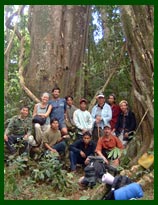
While traversing a sacred forest, the guides explain the medicinal plants and other traditional uses of the forest and point out wild animal tracks. Arrive at a giant strangler fig tree for a break before continuing the journey to a limestone crag for a Lao-style picnic lunch.
A short climb leads through the cave-like crag to a hilltop, before descending to the first Lahu and Khmu village, Ban Nam Kap Tai, where a second village-based guide joins the group.
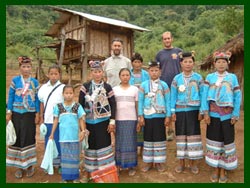
After trekking through the mainly bamboo forest, the final leg of the trail passes through mixed upland agricultural fields and some forest. Arrive in the late afternoon at Ban Nam Paman and Ban Nam Noi, two Lahu villages nestled in the hills, and eat dinner with villagers before an overnight stay in the eco-lodge.
Day 2:
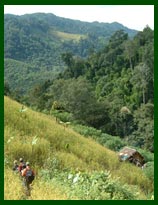
After sharing an early morning meal with the village hosts, embark on a hike through upland rice fields, following the same path traveled daily by locals on their way to work. Enjoy panoramic views of the area from the hilltops, and as the trek passes through swidden fields and secondary growth forest, the guides explain traditional agricultural practices.
The final descent ends at the Nam Fa River, a tributary to the Mekong River, and a relaxing lunch and swim in the mid-day sun. Situated near the river is Ban Vieng Mai, a Tai Lue village, where the group often stops before continuing to the road and a pick up or tuk tuk for the ride to the Eco-Guide Service office in the afternoon.
Walking – moderate to advanced, moderately long days with some steep ascents/descents.
Distance – 25 km (6 hours per day)
Local meals prepared by villagers, water, local guide from town, village guide, accommodation, forest conservation permit, transport, and local taxes
One change of clothes, sandals for the village, good shoes for hiking, sarong for bathing (required for women), mosquito repellent, flashlight, sunscreen/hat, camera, money to purchase handicrafts, sleeping bag (optional – available to borrow if needed)
Local and village guide fees, food sales and preparation, accommodation fees
Do not give individual gifts of sweets or money to children. Ask before taking photos of people or spiritual items. Ask your guide before entering a house or a room inside a house. Help keep the villages clean by not littering. Please purchase handicrafts but do not purchase antiques. Do not wander off designated trails. Do not use drugs in villages.
All treks must be paid for in advance and in cash unless you are booking from elsewhere. Treks can be paid for in Lao kip, US dollars or Thai baht. However, as all local payments must be made in kip, it would be appreciated if you could pay in kip. Please be aware that there is nowhere to officially change money in Vieng Phoukha, and even unofficially you will find it difficult to change anything other than baht or yuan.
With tourist numbers still low, there is no need to book your trek ahead unless you want to arrange a special package. Getting in touch can sometimes be a bit difficult, but try the following phone numbers:
020 5985289 Vongxay (English-speaking lead guide)
020 5101670 Somhak (English-speaking lead guide)